
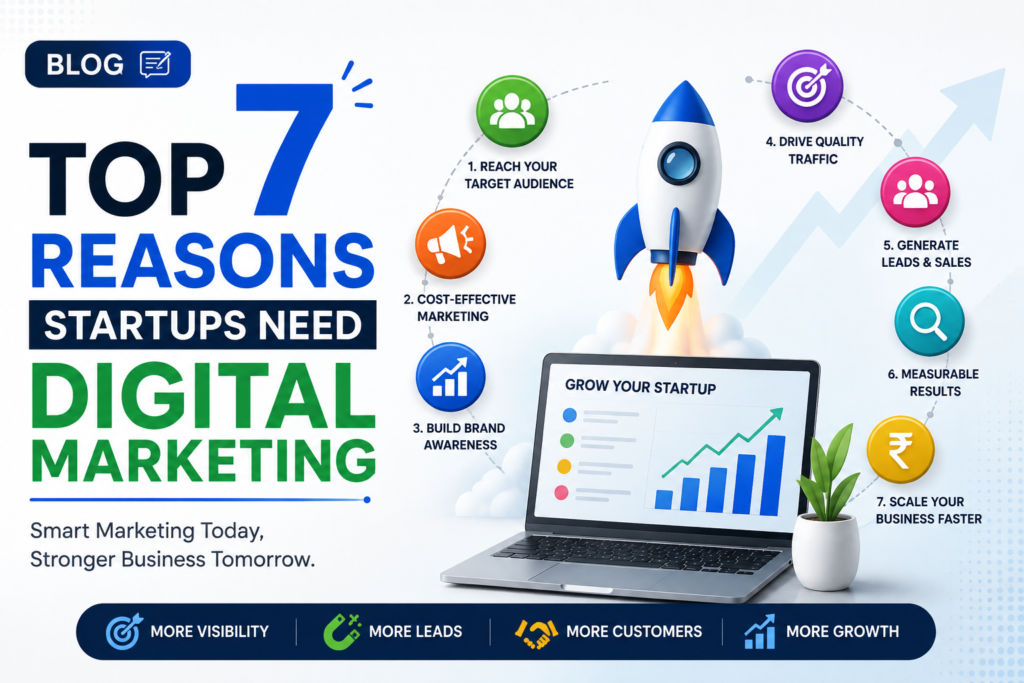
Digital marketing for startups the opportunity to reach the right audience, promote their products or services, generate leads, and build long-term customer relationships without relying entirely on expensive traditional advertising.
From SEO and social media marketing to Google Ads, Meta Ads, content marketing, and email marketing, startups can use multiple digital channels to grow their businesses and compete effectively in today’s online marketplace.
In this blog, we will explore the top 7 reasons startups for digital marketing and how a strong online marketing strategy can support sustainable business growth.
What Is Digital Marketing for Startups?
Digital marketing is the process of promoting a business, product, or service through online channels. These channels include search engines, social media platforms, websites, email, online advertising, video platforms, and content marketing.
startups for digital marketing, can help achieve important business goals such as:
- Building brand awareness
- Reaching potential customers
- Generating qualified leads
- Increasing website traffic
- Improving customer engagement
- Increasing sales
- Building brand credibility
- Measuring marketing performance
Unlike traditional marketing, digital marketing allows startups to track campaign performance and make improvements based on data.
Top 7 Reasons Startups for Digital Marketing
1. Build Brand Awareness Quickly
One of the biggest challenges for a startup is getting people to recognize its brand. Even if you have an excellent product or service, customers cannot buy from you if they do not know your business exists.
Digital marketing allows startups to introduce their brands to potential customers through multiple online channels.
Social media platforms such as Instagram, Facebook, LinkedIn, and YouTube can help startups showcase their products, share educational content, publish customer stories, and communicate their brand personality.
Paid advertising can also increase visibility among specific audiences.
For example, a new local business can use social media advertising to reach people within its service area, while a technology startup can use content marketing and LinkedIn to reach business professionals.
Consistent digital marketing helps startups move from being unknown to becoming recognizable in their target market. This is best reason startups for digital marketing.
2. Reach the Right Target Audience
Traditional advertising often involves reaching a broad audience, even when many people may not be interested in the product or service.
Digital marketing provides much more precise audience targeting.
startups for digital marketing can define their target audience based on factors such as:
- Age
- Location
- Interests
- Online behavior
- Search intent
- Professional background
- Previous website interactions
- Purchasing behavior
For example, a startup selling fitness products can create campaigns focused on people interested in fitness and wellness, while a B2B software startup can target business decision-makers through suitable digital channels.
Search engines also allow businesses to reach people based on what they are actively searching for.
This means startups can focus their limited marketing resources on audiences that are more likely to become customers. This is best reason startups for digital marketing.
3. Generate Leads and New Customers
Getting attention is important, but startups ultimately need customers and revenue.
One of the major benefits of digital marketing is its ability to support lead generation and customer acquisition.
startups for digital marketing can use:
- SEO
- Google Ads
- Meta Ads
- Landing pages
- Social media marketing
- Content marketing
- Email marketing
- WhatsApp marketing
- Lead-generation campaigns
For example, a startup can publish a useful blog article that attracts visitors through Google search. Those visitors can then be directed to a contact form, consultation page, product page, or other conversion point.
Paid advertising can also help businesses reach potential customers faster.
The key is to create a clear customer journey—from discovering the brand to understanding the offer and finally taking action. This is best reason startups for digital marketing.
4. Cost-Effective Marketing for Startups
Startups usually operate with limited budgets. Spending large amounts on traditional advertising without knowing the results can be risky.
Digital marketing can provide more flexible budget options.
For example, businesses can start with a controlled advertising budget and monitor important performance indicators such as:
- Cost per click
- Cost per lead
- Conversion rate
- Customer acquisition cost
- Return on ad spend
- Website traffic
- Sales
If a campaign is performing well, the startup can gradually increase its budget. If a campaign is not producing satisfactory results, the business can adjust the audience, creative, message, landing page, or campaign strategy.
This flexibility makes digital marketing a practical option for startups with limited marketing budgets.
However, cost-effectiveness does not mean digital marketing is automatically cheap. Poor targeting, weak content, ineffective landing pages, and untracked campaigns can still waste money.
The focus should always be on generating measurable business results. This is best reason startups for digital marketing.
5. Compete With Larger Businesses
Many startups assume that established companies have an unbeatable advantage because they have larger budgets and greater brand recognition.
Digital marketing can help reduce this gap.
A startup can create high-quality content, optimize its website for search engines, build an engaged social media audience, and run targeted advertising campaigns.
For example, a small business may compete for specific long-tail search keywords rather than attempting to rank immediately for extremely competitive keywords.
A startup can also establish authority by publishing helpful guides, answering customer questions, creating videos, and sharing industry insights.
The objective is not necessarily to compete with large businesses everywhere. Instead, startups should identify specific niches and audiences where they can provide greater value.
With a focused digital marketing strategy, even a small company can build strong online visibility. This is best reason startups for digital marketing.
6. Build Customer Trust and Credibility
Customers are more likely to purchase from businesses they trust.
For a new startup without years of market history, building credibility is particularly important.
A professional website, active social media presence, useful content, customer reviews, testimonials, case studies, and informative videos can all contribute to building trust.
For example, a potential customer who discovers a startup through Google may visit its website before making a decision. If the website is outdated, difficult to navigate, or missing important information, the customer may leave.
On the other hand, a professional website containing clear service information, customer reviews, useful content, contact details, and strong branding can create a more positive impression.
Digital marketing therefore does more than generate traffic. It can help communicate why customers should trust your business. This is best reason startups for digital marketing.
7. Measure Results and Make Data-Driven Decisions
Another major reason startups need digital marketing is measurability.
Traditional advertising can sometimes make it difficult to determine exactly how many customers responded to an advertisement.
Digital marketing provides access to a wide range of performance data.
Startups can track metrics such as:
- Website visitors
- Traffic sources
- Leads generated
- Conversion rates
- Social media engagement
- Advertising clicks
- Cost per lead
- Customer acquisition cost
- Sales
- Return on advertising spend
This information allows startups to make better decisions.
For example, suppose a startup is running two advertising campaigns. Campaign A generates 100 leads at a high cost, while Campaign B generates 70 leads at a much lower cost. Looking only at the number of leads might make Campaign A appear better. However, analyzing cost per lead and lead quality could show that Campaign B is more profitable. This is best reason startups for digital marketing.
Data helps startups understand what works, what does not work, and where marketing budgets should be allocated.
Digital Marketing Channels Startups Should Consider
There are many digital marketing channels available, but startups do not necessarily need to use every channel immediately.
Search Engine Optimization
SEO helps businesses attract organic traffic from search engines. It is particularly valuable for startups looking to build long-term online visibility.
Social Media Marketing
Social media helps startups build communities, increase brand awareness, communicate with customers, and distribute content.
Google Ads
Google Ads can help startups reach people who are actively searching for relevant products and services.
Meta Ads
Meta Ads can help startups reach targeted audiences through Facebook and Instagram and can support objectives such as awareness, traffic, leads, and conversions.
Content Marketing
Blogs, guides, videos, case studies, and educational content can help startups attract potential customers and establish expertise.
Email Marketing
Email marketing can help startups nurture leads, communicate with customers, promote offers, and build long-term relationships.
The best channel depends on the startup’s industry, target audience, business model, goals, and budget.
How to Create a Digital Marketing Strategy for a Startup
A successful strategy should begin with clear planning.
Step 1: Define Your Ideal Customer
Identify who you want to reach. Understand their problems, needs, interests, location, and buying behavior. This is best strategy startups for digital marketing to grow your business.
Step 2: Set Specific Goals
Your goals might include generating leads, increasing sales, improving website traffic, building brand awareness, or acquiring new customers. This is best strategy startups for digital marketing to grow your business.
Step 3: Select the Right Channels
Choose marketing channels based on where your target audience spends time and where your startup can achieve measurable results. This is best strategy startups for digital marketing to grow your business.
Step 4: Create Valuable Content
Develop content that answers customer questions and solves real problems instead of constantly promoting your business. This is best strategy startups for digital marketing to grow your business.
Step 5: Set Your Budget
Determine how much you can invest in SEO, advertising, content creation, website development, social media, and other marketing activities. This is best strategy startups for digital marketing to grow your business.
Step 6: Track Performance
Monitor KPIs and conversion data regularly. Do not evaluate campaigns only on likes, impressions, or clicks. This is best strategy startups for digital marketing to grow your business.
Step 7: Optimize Continuously
Test different messages, audiences, creatives, keywords, offers, and landing pages. Keep improving based on actual results. This is best strategy startups for digital marketing to grow your business.
Common Digital Marketing Mistakes Startups Should Avoid
Although digital marketing provides many opportunities, startups can lose money and time without proper planning.
Common mistakes include:
- Trying to target everyone
- Not defining a clear target audience
- Using every marketing channel at once
- Ignoring SEO
- Having a poor website experience
- Posting inconsistently
- Running ads without conversion tracking
- Focusing only on followers and likes
- Not testing different campaigns
- Expecting immediate SEO results
- Creating content without understanding customer needs
Avoiding these mistakes allows startups to use their resources more efficiently.
Why Digital Marketing Is Essential for Startup Growth
The modern customer journey often begins online. People search for information, compare businesses, read reviews, watch videos, explore social media profiles, and visit websites before making purchasing decisions.
If a startup does not have a strong online presence, it may miss valuable opportunities to reach potential customers.
Digital marketing helps startups become visible at different stages of the customer journey.
A potential customer may first discover your brand through social media, read your blog through Google, watch one of your videos, visit your website, and eventually contact your business.
This combination of channels can create a strong and consistent customer experience.
Final Thoughts
The digital marketplace provides startups with an opportunity to build visibility, reach targeted audiences, generate leads, establish credibility, and compete with larger businesses.
The top 7 reasons startups for digital marketing are clear: it helps build brand awareness, reach the right audience, generate customers, manage marketing budgets effectively, compete in the market, build trust, and make data-driven decisions. If you are interesting in digital marketing services then contact with us .