
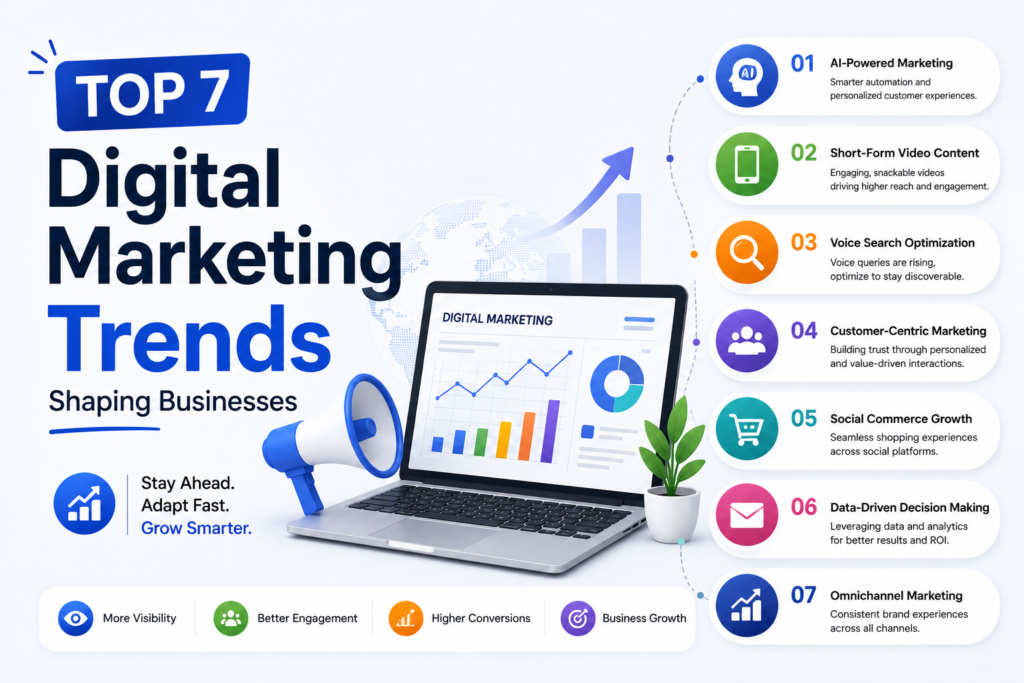
The digital landscape is changing rapidly, and businesses that fail to adapt risk losing visibility, customers, and market share. From artificial intelligence and short-form video to personalized customer experiences and data-driven advertising, digital marketing trends are transforming the way businesses attract and engage customers.
Today, customers spend a significant amount of time online researching products, comparing brands, reading reviews, watching videos, and interacting with businesses on social media. As a result, having a strong digital presence is no longer optional—it is an important part of modern business growth.
Whether you are a startup, small business, or established company, understanding the latest digital marketing trends can help you make better marketing decisions, improve customer engagement, and build a stronger competitive advantage.
In this blog, we explore the top 7 digital marketing trends shaping businesses and explain how you can use them to strengthen your marketing strategy.
What Are Digital Marketing Trends?
Digital marketing trends are emerging technologies, strategies, platforms, and customer behaviors that influence how businesses promote their products and services online.
These Digital marketing trends can affect areas such as:
- Search engine optimization
- Social media marketing
- Paid advertising
- Content marketing
- Customer experience
- Email marketing
- Video marketing
- Artificial intelligence
- Data analytics
Following digital marketing trends does not mean businesses should blindly adopt every new technology. Instead, businesses should identify trends that are relevant to their customers and business objectives.
Top 7 Digital Marketing Trends Shaping Businesses
1. Artificial Intelligence in Digital Marketing
Artificial intelligence (AI) is one of the most important digital marketing trends shaping businesses today.
AI is changing how businesses create content, analyze data, understand customers, automate tasks, and optimize campaigns.
Marketing teams can use AI-powered tools to assist with:
- Content ideas
- Customer research
- Data analysis
- Audience segmentation
- Ad optimization
- Chatbots
- Email personalization
- Predictive analytics
- Marketing automation
AI can help businesses save time and process large amounts of information more efficiently. For example, marketers can analyze customer behavior and identify patterns that may help improve campaign targeting.
However, AI should support human creativity and strategic thinking rather than completely replace them. High-quality marketing still requires brand understanding, original ideas, fact-checking, emotional intelligence, and knowledge of the target audience.
Businesses that combine AI technology with human expertise can improve productivity while maintaining authentic communication. This is best digital marketing trends shaping strategies for your business.
2. Short-Form Video Marketing
Short-form video has become a powerful way for businesses to capture audience attention.
Platforms such as Instagram Reels, YouTube Shorts, and similar video formats provide businesses with opportunities to communicate their messages quickly and creatively.
Short-form videos can be used for:
- Product demonstrations
- Educational tips
- Customer testimonials
- Behind-the-scenes content
- Product launches
- Frequently asked questions
- Industry tips
- Brand storytelling
- Offers and promotions
One advantage of short-form video is that businesses can communicate information in an easy-to-consume format.
For example, a digital marketing agency can create a short video explaining “3 Meta Ads mistakes businesses should avoid.” A restaurant can showcase a popular dish, while a clothing brand can demonstrate different ways to style a product.
The key is to create videos that provide value, entertainment, education, or a strong reason to keep watching.
Businesses should focus less on simply creating videos and more on creating content that matches the interests and problems of their target audience. This is best digital marketing trends shaping strategies for your business.
3. Personalized Customer Experiences
Customers increasingly expect brands to understand their interests and provide relevant experiences.
Personalization allows businesses to customize marketing messages based on customer preferences, behavior, previous interactions, or purchasing history.
Examples of personalization include:
- Personalized email recommendations
- Product suggestions
- Customized offers
- Audience-specific advertisements
- Personalized website experiences
- Relevant content recommendations
- Customer segmentation
For example, an online store can recommend products based on a customer’s previous browsing or purchasing behavior.
Email marketing can also become more effective when businesses send relevant messages to specific customer segments instead of sending the same email to everyone.
Personalization can help businesses improve engagement and create stronger customer relationships.
However, businesses should use customer data responsibly and transparently. Personalization should make the customer experience more useful rather than intrusive. This is best digital marketing trends shaping strategies for your business.
4. Search Engine Optimization Is Becoming More Intent-Focused
SEO continues to be an important digital marketing strategy, but the way businesses approach search optimization is evolving.
Instead of focusing only on individual keywords, businesses should understand search intent and create content that genuinely answers what users are trying to accomplish.
Search intent can generally include:
- Informational searches
- Navigational searches
- Commercial research
- Transactional searches
For example, someone searching for “what is SEO” is likely looking for information, while someone searching for “SEO agency near me” may have stronger commercial intent.
Businesses should create content that directly addresses these different needs.
Modern SEO also requires attention to:
- Helpful and original content
- Website experience
- Mobile usability
- Page performance
- Internal linking
- Structured content
- Local SEO
- Search visibility across evolving search experiences
Instead of creating content simply to rank for keywords, businesses should focus on becoming a useful and trustworthy resource for their target audience. This is best digital marketing trends shaping strategies for your business.
5. Social Commerce and Social Media Selling
Social media is no longer only a platform for building awareness and engagement. It is increasingly becoming part of the customer journey from discovery to purchase.
Businesses can use social platforms to showcase products, educate customers, answer questions, build trust, and direct users toward purchasing opportunities.
Social commerce strategies can include:
- Product-focused videos
- Influencer collaborations
- Social media promotions
- Product demonstrations
- Customer-generated content
- Shoppable experiences where available
- Direct messaging for customer inquiries
For businesses selling visual products, social media can be especially valuable.
For example, a fashion brand can showcase new collections through short videos, while a food business can use social media to display products and encourage customers to place orders.
The important factor is to make the customer journey as simple as possible—from discovering a product to understanding its benefits and taking action. This is best digital marketing trends shaping strategies for your business.
6. Data-Driven Marketing and Analytics
Modern businesses have access to more marketing data than ever before. However, collecting data is not enough. Businesses need to understand what the data means and use it to improve their decisions.
Data-driven marketing involves using customer and campaign information to evaluate performance and optimize marketing activities.
Businesses can monitor metrics such as:
- Website traffic
- Conversion rate
- Cost per lead
- Customer acquisition cost
- Return on ad spend
- Engagement rate
- Email performance
- Organic search traffic
- Sales revenue
For example, suppose a company runs two advertising campaigns. One campaign generates more clicks, while another generates fewer clicks but more qualified leads. Looking only at traffic could lead to the wrong conclusion.
Analyzing conversion and lead quality can reveal which campaign actually contributes more to business growth.
Businesses should therefore focus on meaningful performance metrics rather than vanity metrics alone.
Regular analysis allows marketers to identify what is working, what needs improvement, and where the marketing budget should be invested. This is best digital marketing trends shaping strategies for your business.
7. Omnichannel Marketing and Integrated Customer Journeys
Customers rarely interact with a brand through only one channel.
A potential customer might discover a business through Instagram, search for the company on Google, visit its website, watch a YouTube video, read reviews, and finally contact the business through WhatsApp or email.
This is why omnichannel marketing is becoming increasingly important.
Omnichannel marketing focuses on creating a connected customer experience across multiple channels.
These channels may include:
- Website
- Google Search
- YouTube
- Online advertising
- Offline customer touchpoints
The objective is to provide a consistent brand experience regardless of where the customer interacts with the business.
For example, a customer who sees an advertisement on Instagram should find consistent messaging when they visit the company’s website.
Integrated marketing can help businesses create smoother customer journeys and reduce confusion between different marketing channels. This is best digital marketing trends shaping strategies for your business.
Why Businesses Should Follow Digital Marketing Trends
Following relevant digital marketing trends can provide several advantages.
Stay Competitive
Markets are becoming increasingly competitive. Businesses that understand changing customer behavior can adapt faster and identify new opportunities.
Improve Customer Engagement
New content formats, personalization, and social media strategies can help businesses communicate more effectively with their audiences.
Increase Marketing Efficiency
Automation, AI, and analytics can help marketing teams save time and improve campaign management.
Make Better Decisions
Data provides businesses with valuable insights that can support more informed marketing decisions.
Reach Customers Where They Spend Time
Customers continuously change how they consume content and discover brands. Businesses need to adapt their marketing channels accordingly.
How to Implement These Digital Marketing Trends
Businesses should not adopt every trend at the same time. A better approach is to identify trends that align with specific business goals.
Step 1: Understand Your Audience
Research your customers’ needs, preferences, online behavior, and purchasing journey.
Step 2: Identify Your Marketing Goals
Define whether your priority is brand awareness, website traffic, lead generation, sales, customer retention, or another measurable objective.
Step 3: Select Relevant Trends
Choose the trends that can directly support your business goals. A B2B company may prioritize LinkedIn content and lead generation, while a consumer brand may focus more heavily on short-form video and social commerce.
Step 4: Test Small Campaigns
Do not invest your entire marketing budget into a new strategy immediately. Start with controlled tests and measure the results.
Step 5: Analyze Performance
Track relevant KPIs and compare results against your business objectives.
Step 6: Optimize and Scale
Continue improving strategies that generate positive results and reduce investment in activities that consistently underperform.
Common Mistakes Businesses Should Avoid
While following digital marketing trends can create opportunities, businesses should avoid adopting trends simply because they are popular.
Common mistakes include:
- Following trends without understanding the target audience
- Using AI without human review
- Creating low-quality content
- Focusing only on views and likes
- Ignoring customer feedback
- Running campaigns without tracking conversions
- Using too many marketing channels at once
- Neglecting website performance
- Failing to maintain consistent branding
- Expecting immediate results from every strategy
The most successful businesses focus on strategy first and technology second.
The Future of Digital Marketing
Digital marketing will continue to evolve as technology and customer expectations change.
Artificial intelligence, automation, video content, personalization, analytics, search evolution, and integrated customer experiences are likely to remain important areas for marketers.
However, one principle will continue to matter: understanding the customer.
Technology can help businesses reach people faster and analyze information more effectively, but successful marketing still depends on providing something valuable to customers.
Businesses that continuously learn, test new ideas, analyze results, and adapt to changing customer behavior will be better positioned for long-term success.
Final Thoughts
The top 7 digital marketing trends shaping businesses include artificial intelligence, short-form video, personalization, intent-focused SEO, social commerce, data-driven marketing, and omnichannel customer experiences.
These trends are changing how businesses attract customers, communicate their value, generate leads, and build relationships.
Start by understanding your audience, choose the most relevant digital marketing trends, test your strategy, measure the results, and continuously optimize your campaigns. If you are interesting in digital marketing trends shaping to your business then Contact With Us.