
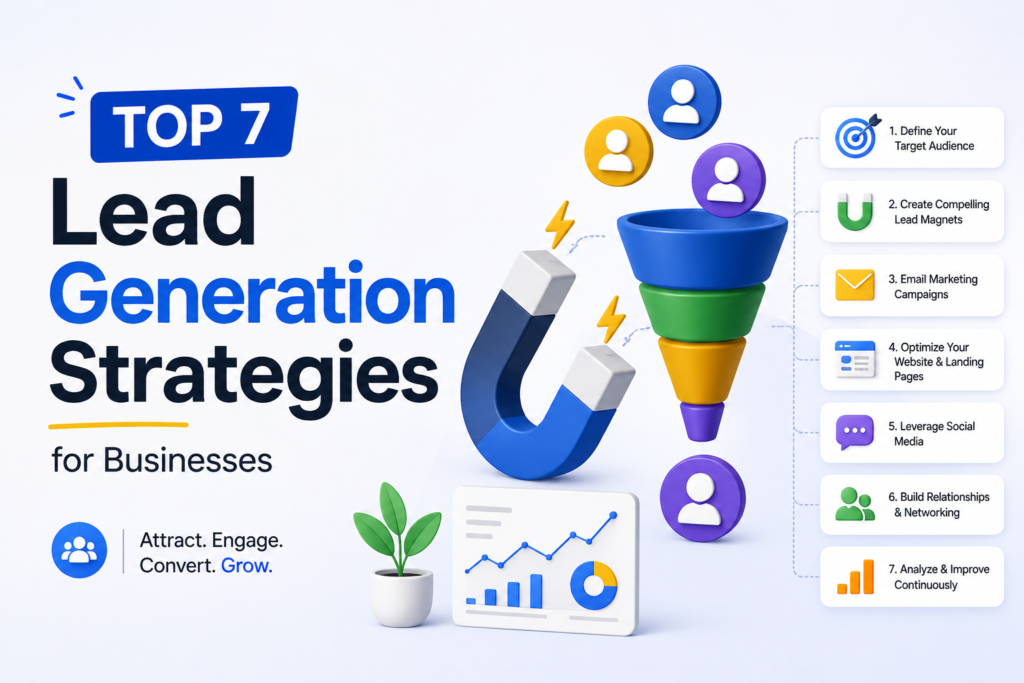
Generating a steady flow of qualified leads is one of the biggest priorities for businesses today. Whether you are a startup, small business, service provider, or established enterprise, attracting potential customers is essential for sustainable growth.
However, getting website visitors is not the same as generating leads. A successful lead generation strategy focuses on attracting the right audience, building trust, encouraging action, and converting interested prospects into potential customers.
With increasing competition online, businesses need a combination of organic and paid marketing strategies to generate consistent results. Search engines, social media platforms, paid advertising, content marketing, email campaigns, and optimized landing pages can all play an important role.
In this blog, we will explore the Top 7 Lead Generation Strategies for Businesses and explain how you can use them to attract more qualified prospects and grow your business.
What Is Lead Generation Strategies?
Lead generation strategies is the process of attracting people who are interested in your products or services and encouraging them to provide their contact information or take a valuable action.
A lead may be someone who:
- Fills out a contact form
- Requests a quotation
- Calls your business
- Sends a WhatsApp inquiry
- Downloads an eBook or guide
- Registers for a webinar
- Signs up for an email newsletter
- Books an appointment
- Requests a product demonstration
The goal is not simply to collect as many contacts as possible. The objective is to generate quality leads that have a genuine interest in what your business offers.
Why Is Lead Generation Strategies Important for Businesses?
Effective lead generation strategies helps businesses create a predictable path from marketing activity to potential sales.
Some important benefits include:
- Increased number of potential customers
- Better sales opportunities
- Improved brand visibility
- More website conversions
- Better use of marketing budgets
- Stronger customer relationships
- Support for long-term business growth
A well-planned lead generation strategy can also help your sales team spend more time communicating with prospects who are genuinely interested.
Now, let’s look at the seven lead generation strategies businesses can use to generate leads.
1. Use SEO to Attract Organic Leads
Search Engine Optimization (SEO) is one of the most valuable long-term lead generation strategies.
People frequently use search engines to find solutions, products, and services. If your website appears when potential customers search for relevant keywords, you can attract visitors who already have an interest in your offering.
For example, a digital marketing agency may target keywords such as:
- Digital marketing agency
- SEO services
- Google Ads management
- Social media marketing services
- Website development services
To generate leads through SEO, businesses should focus on creating useful, search-friendly content and optimizing important website pages.
Key SEO activities include:
- Keyword research
- On-page SEO
- Technical SEO
- Local SEO
- Content creation
- Internal linking
- Website speed optimization
- Mobile optimization
- Building relevant authority
The major advantage of SEO is that it can generate organic traffic without paying for every individual click. However, SEO generally requires consistent effort and time to build visibility. This is best lead generation strategies for your business.
2. Run Targeted Google Ads Campaigns
Google Ads can help businesses reach people who are actively searching for their products or services.
For lead generation, Search campaigns can be particularly useful because advertisements can appear when users search for commercial keywords.
For example, someone searching for “best digital marketing agency for startups” may already be interested in hiring a service provider.
To improve Google Ads lead generation:
- Target relevant keywords
- Use appropriate match types
- Add negative keywords
- Write compelling ad copy
- Use location targeting when relevant
- Create dedicated landing pages
- Set up conversion tracking
- Monitor cost per lead
- Optimize campaigns regularly
Businesses should avoid focusing only on clicks. The real objective is to generate qualified inquiries, calls, registrations, or sales.
A properly structured Google Ads campaign can provide faster visibility than waiting for organic rankings, making paid search useful for businesses that need to generate leads more quickly. This is best lead generation strategies for your business.
3. Leverage Social Media Marketing
Social media platforms provide businesses with opportunities to reach potential customers, build relationships, and generate inquiries.
Platforms such as Instagram, Facebook, LinkedIn, and YouTube can be used depending on your target audience and business model.
Social media lead generation strategies can include:
- Organic posts
- Short-form videos
- Educational content
- Customer testimonials
- Live sessions
- Lead generation advertisements
- Direct messages
- Website traffic campaigns
- Promotional offers
For example, a local restaurant may use Instagram and Facebook to promote special offers, while a B2B company may use LinkedIn to connect with decision-makers.
Consistency is important. Businesses should focus on providing useful content instead of posting only promotional messages.
A strong social media strategy can build trust before a customer is ready to contact your business. This is best lead generation strategies for your business.
4. Create High-Converting Landing Pages
A landing page can have a major impact on your lead generation results.
You may generate traffic through SEO, Google Ads, Meta Ads, social media, or email marketing, but if your landing page is difficult to understand or navigate, visitors may leave without taking action.
An effective lead generation landing page should have:
A Clear Headline
The headline should immediately explain what you offer.
Strong Value Proposition
Tell visitors why they should choose your product or service.
Relevant Benefits
Focus on how your offering can solve the customer’s problem.
Strong Call to Action
Use clear actions such as:
- Get a Free Consultation
- Request a Quote
- Book a Call
- Contact Us
- Get Started
Simple Lead Form
Ask only for information that is necessary at the initial stage.
Trust Elements
Testimonials, reviews, case studies, certifications, and other relevant trust signals can help reduce customer hesitation.
Your landing page should also be mobile-friendly and load quickly because many users access websites through smartphones. This is best lead generation strategies for your business.
5. Use Content Marketing to Build Trust
Content marketing is another powerful way to generate leads.
Instead of constantly asking customers to buy, businesses can create useful content that answers questions and solves problems.
Examples include:
- Blog articles
- How-to guides
- Case studies
- Videos
- Infographics
- eBooks
- Industry reports
- Checklists
- Webinars
- Frequently asked questions
For example, a website development company could publish content such as “Top Website Design Trends for Businesses” or “How to Choose the Right Website Development Company.”
Useful content can attract search traffic, demonstrate expertise, and move prospects further through the buying journey.
You can also use content as a lead magnet. Offer valuable resources in exchange for information such as a name and email address.
The key is to ensure the content provides genuine value rather than simply being created to promote a business. This is best lead generation strategies for your business.
6. Use Email Marketing for Lead Nurturing
Not every lead is ready to purchase immediately.
Some prospects may need more information before making a decision. This is where email marketing can help.
Once someone provides permission to receive communications, businesses can use email campaigns to nurture the relationship.
Email content may include:
- Educational information
- Product updates
- Special offers
- Industry insights
- Case studies
- Helpful tips
- New blog posts
- Event invitations
A basic lead nurturing sequence might include:
Email 1: Welcome and introduction
Email 2: Helpful educational content
Email 3: Explain your solution
Email 4: Share proof or customer success
Email 5: Provide a relevant offer or call to action
Personalization and segmentation can make email campaigns more relevant.
The objective should be to provide value and guide prospects toward a useful next step rather than sending excessive promotional messages. This is best lead generation strategies for your business.
7. Use Retargeting to Reconnect With Interested Visitors
Many people will visit your website without becoming a lead during their first visit.
They may be researching different companies, comparing prices, or simply not be ready to make a decision.
Retargeting can help businesses reconnect with people who have previously interacted with their website, content, or advertising, subject to platform policies and applicable privacy requirements.
For example, a visitor may view your website development service page but leave without contacting you. A relevant retargeting campaign can remind them about your business later.
Retargeting can be used to promote:
- Special offers
- Free consultations
- Product demonstrations
- Downloadable resources
- Services
- New content
- Limited-time promotions
The messaging should remain relevant and should not overwhelm users with excessive advertisements. This is best lead generation strategies for your business.
How to Choose the Right Lead Generation Strategy
Not every strategy will work equally well for every business.
Your choice should depend on factors such as:
- Target audience
- Industry
- Marketing budget
- Business location
- Sales cycle
- Product or service price
- Customer buying behavior
- Business objectives
For example, a local service business may benefit from Local SEO + Google Ads + landing pages, while a B2B company may focus more heavily on SEO + LinkedIn + content marketing + email nurturing.
An e-commerce business may prioritize SEO + Google Ads + social media advertising + retargeting.
The best approach is usually a combination of multiple channels rather than depending on only one source of leads.
How to Measure Lead Generation Strategies Performance
You cannot improve what you do not measure.
Important lead generation metrics include:
- Number of leads
- Qualified leads
- Conversion rate
- Cost per lead
- Customer acquisition cost
- Website conversion rate
- Lead-to-customer rate
- Return on advertising spend
- Sales revenue generated
For paid campaigns, monitor how much you spend compared with the number and quality of leads generated.
For SEO and content marketing, monitor organic traffic, keyword visibility, engagement, and conversions.
Most importantly, connect marketing data with actual sales outcomes whenever possible. A channel that generates fewer leads but produces more customers may be more valuable than one generating a large volume of low-quality inquiries.
Common Lead Generation Strategies Mistakes to Avoid
Businesses often make several mistakes when trying to generate leads online.
Targeting Everyone
Trying to reach everyone can make your marketing message less relevant. Define your ideal customer clearly.
Using Weak Calls to Action
Tell visitors exactly what they should do next.
Ignoring Mobile Users
Make sure your forms, landing pages, and advertisements work properly on mobile devices.
Not Following Up Quickly
A lead can lose interest if there is a long delay before receiving a response.
Focusing Only on Lead Quantity
More leads do not automatically mean more sales. Focus on lead quality as well.
Not Tracking Results
Without proper tracking, it becomes difficult to identify which channels are producing valuable customers.
Final Thoughts
Lead generation strategies is an essential part of modern business growth. Whether you are a startup, small business, or established company, having a reliable system for attracting and nurturing potential customers can create valuable opportunities. If you are interested in lead generation strategies to grow your business then Contact With Us.