
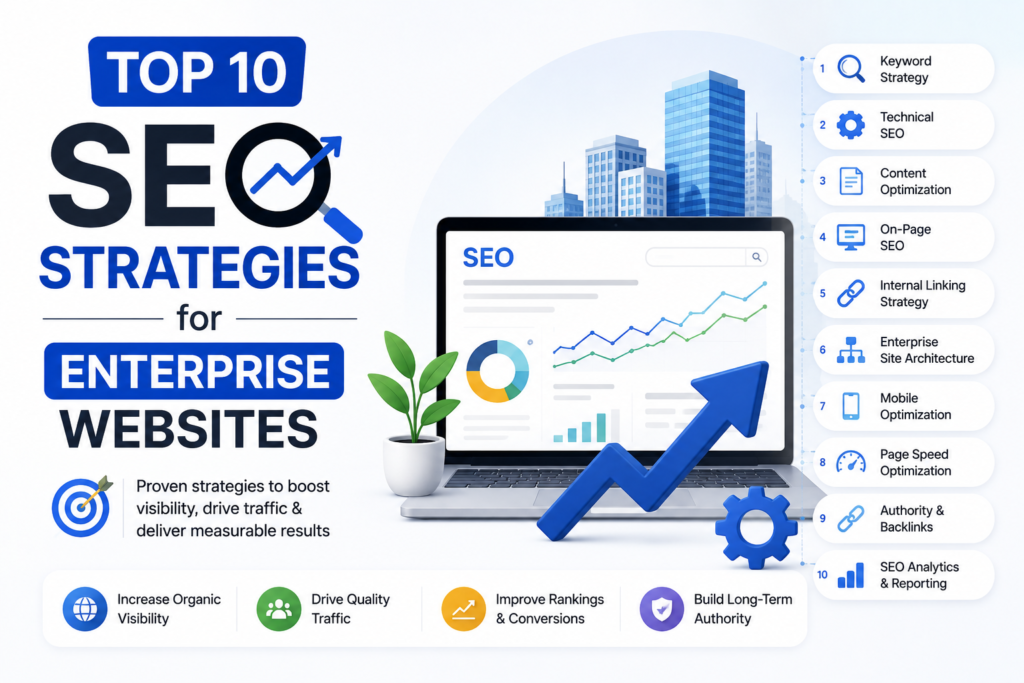
Meta Description: Discover the top 10 SEO strategies for enterprise websites to improve search rankings, organic traffic, technical performance, and business visibility.
Focus Keyword: SEO Strategies for Enterprise Websites
Secondary Keywords: enterprise SEO strategies, enterprise SEO, SEO for enterprise websites, enterprise website optimization, enterprise search engine optimization
Enterprise websites are often much larger and more complex than standard business websites. They may contain thousands of pages, multiple product categories, different locations, several departments, and large amounts of content. Because of this complexity, traditional SEO techniques alone may not be enough.
Enterprise SEO strategies requires a structured approach that combines technical optimization, content strategy, keyword research, internal linking, website architecture, authority building, and continuous performance monitoring.
For large organizations, even small improvements in organic search visibility can generate significant increases in traffic, leads, sales, and brand exposure. However, managing SEO across thousands of pages also creates challenges such as duplicate content, indexing problems, keyword cannibalization, slow page speed, inconsistent content, and complicated site structures.
In this article, we will explore the Top 10 SEO Strategies for Enterprise Websites and explain how large businesses can build a scalable SEO strategy for long-term organic growth.
What Is Enterprise SEO Strategies For ?
Enterprise SEO is the process of optimizing large websites to improve their visibility in search engine results and attract relevant organic traffic.
Enterprise websites may include:
- E-commerce websites
- Large corporate websites
- SaaS platforms
- Financial institutions
- Travel websites
- Healthcare organizations
- Educational platforms
- Multi-location businesses
- Large marketplaces
Unlike small websites, enterprise websites often have thousands or even millions of URLs. This makes scalability and automation important parts of an enterprise SEO strategy.
The objective is not simply to rank one page. The goal is to create a search-friendly website structure that allows search engines to efficiently discover, understand, index, and rank valuable pages.
Why Is SEO Important for Enterprise Websites?
Organic search can become an important source of sustainable traffic for large businesses.
A strong enterprise SEO strategy can help organizations:
- Increase organic website traffic
- Improve visibility for important keywords
- Generate qualified leads
- Increase online sales
- Strengthen brand authority
- Improve user experience
- Reduce dependence on paid advertising
- Reach customers at different stages of the buying journey
Because enterprise websites often target multiple products, services, markets, and locations, SEO can help them capture a wide range of relevant search queries. This is best enterprise SEO strategies for business.
Let’s explore the ten most important enterprise SEO strategies.
1. Build a Scalable Website Architecture
A well-organized website architecture is one of the foundations of enterprise SEO strategies.
Search engines need to understand the relationship between different pages on your website. Users should also be able to navigate easily between categories, products, services, and supporting content.
A logical structure could look like:
Homepage → Category → Subcategory → Product/Service → Supporting Content
For example, an enterprise technology company might structure its website as:
Technology → Cloud Solutions → Cloud Security → Cloud Security Services
A clear architecture can help distribute internal authority and make important pages easier to discover.
Avoid creating unnecessarily deep page structures. Important pages should generally be accessible through logical navigation and internal links. This is best enterprise SEO strategies for business.
2. Conduct Enterprise-Level Keyword Research
Keyword research becomes more complex when a website has thousands of pages.
Instead of focusing only on individual keywords, enterprise businesses should organize keywords into topics, search intent, categories, and customer journeys.
Keyword research can identify:
- Commercial keywords
- Informational keywords
- Transactional keywords
- Navigational keywords
- Product-related searches
- Location-based searches
- Long-tail keywords
- Question-based searches
Create keyword groups for different website sections and map them to appropriate pages.
This helps prevent multiple pages from competing for the same primary keyword, a problem commonly known as keyword cannibalization.
Keyword research should also consider search intent. A user searching for “what is cloud computing” has a different intent from someone searching for “cloud computing services.”
Creating content that matches each intent can improve both relevance and user experience. This is best enterprise SEO strategies for business.
3. Optimize Technical SEO at Scale
Technical SEO is particularly important for enterprise websites because a small technical issue can affect thousands of pages.
Regularly monitor areas such as:
- Crawlability
- Indexability
- XML sitemaps
- Robots.txt
- Canonical tags
- Redirects
- Broken links
- HTTPS
- Mobile usability
- Page speed
- Structured data
- URL structure
Enterprise websites should establish regular technical SEO audits to identify problems before they become widespread.
Automated monitoring can also help identify sudden increases in broken pages, server errors, indexing issues, or other technical problems.
The objective is to make it easy for search engines to access and understand the pages that matter most. This is best enterprise SEO strategies for business.
4. Improve Website Speed and Core Web Vitals
Website performance affects both user experience and search visibility.
Large enterprise websites can become slow because of:
- Large images
- Heavy JavaScript
- Third-party scripts
- Complex tracking systems
- Poor server configuration
- Excessive plugins
- Unoptimized code
- Large media files
Improving page performance can create a better experience for visitors and support overall SEO performance.
Focus on areas such as:
- Image optimization
- Browser caching
- Efficient code
- Content delivery networks
- Server performance
- Mobile optimization
- Reducing unnecessary scripts
Monitor Google’s Core Web Vitals and other performance indicators regularly.
Performance optimization should be treated as an ongoing process rather than a one-time task. This is best enterprise SEO strategies for business.
5. Create High-Quality, Search-Focused Content
Enterprise websites often have a huge content opportunity, but quantity should not replace quality.
Create useful content that answers real customer questions and demonstrates expertise.
Enterprise content can include:
- Product pages
- Service pages
- Industry guides
- Blog articles
- Case studies
- Research reports
- Comparison pages
- FAQs
- Tutorials
- Customer resources
Each page should have a clear purpose and target audience.
Avoid creating hundreds of similar pages simply to target minor keyword variations. Search engines increasingly reward useful content that provides genuine value to users.
A strong enterprise content strategy should combine keyword research with customer needs, industry expertise, and business objectives. This is best enterprise SEO strategies for business.
6. Strengthen Internal Linking
Internal linking is one of the most useful enterprise SEO strategies because large websites have thousands of opportunities to connect related pages.
Strategic internal links can help:
- Search engines discover pages
- Users navigate the website
- Distribute internal authority
- Establish topic relationships
- Support important landing pages
For example, a detailed article about “enterprise cybersecurity” could link naturally to relevant cybersecurity services, solutions, case studies, and supporting resources.
Use descriptive anchor text that clearly communicates the destination page.
Avoid adding internal links randomly. Links should be useful to users and relevant to the surrounding content. This is best enterprise SEO strategies for business.
7. Manage Duplicate Content and Canonicalization
Large websites frequently face duplicate or near-duplicate content problems.
Duplicate content can occur because of:
- Product variations
- URL parameters
- Filter pages
- Sorting options
- Printer-friendly pages
- Multiple versions of URLs
- Similar location pages
- Syndicated content
- E-commerce category structures
Search engines may have difficulty determining which version of a page should be indexed and ranked.
Enterprise websites should establish clear URL and canonicalization rules.
Depending on the situation, solutions may include:
- Canonical tags
- Redirects
- Consistent internal linking
- Appropriate robots directives
- Parameter handling
- Removing unnecessary URLs
The goal is to make the preferred version of important content clear. This is best enterprise SEO strategies for business.
8. Develop a Strong Local SEO Strategy for Multiple Locations
Many enterprise businesses operate across multiple cities, regions, or countries.
For these organizations, local SEO can be a major source of qualified traffic.
Create useful location pages when there is a genuine business presence and unique value for users.
A strong multi-location SEO strategy can include:
- Location-specific landing pages
- Consistent business information
- Local keyword research
- Location-focused content
- Relevant internal linking
- Local business structured data where appropriate
- Local listings and citations
- Customer reviews
Avoid creating hundreds of low-quality location pages that contain almost identical content with only the city name changed.
Each location page should provide meaningful information for customers in that area. This is best enterprise SEO strategies for business.
9. Build High-Quality Backlinks and Digital Authority
Backlinks remain an important part of SEO because relevant links can help establish authority and credibility.
Enterprise businesses often have opportunities to earn links through:
- Original research
- Industry reports
- Digital PR
- Expert insights
- Case studies
- Useful tools
- Data-driven content
- Partnerships
- Industry publications
Focus on earning relevant, high-quality links rather than collecting a large number of low-quality backlinks.
A large enterprise brand may already have strong authority, but individual sections of the website may still need strategic internal linking and external references to strengthen their visibility.
Quality, relevance, and natural acquisition should be the priorities. This is best enterprise SEO strategies for business.
10. Use SEO Data, Automation, and Continuous Optimization
Enterprise SEO generates enormous amounts of data.
Businesses should use analytics and SEO platforms to monitor:
- Organic traffic
- Keyword rankings
- Click-through rates
- Indexed pages
- Crawl errors
- Conversions
- Revenue
- Landing page performance
- Backlinks
- Search trends
Automation can also help large organizations identify issues quickly.
For example, automated systems can flag:
- Broken links
- Missing metadata
- Duplicate title tags
- Missing canonical tags
- Slow pages
- Indexing changes
- Redirect errors
However, automation should support SEO teams rather than replace strategic decision-making.
Regular reporting allows businesses to identify opportunities, prioritize important problems, and measure the impact of SEO activities. This is best enterprise SEO strategies for business.
Common Enterprise SEO Strategies Mistakes to Avoid
Large organizations often have complex teams and workflows, which can create SEO challenges.
Some common mistakes include:
Ignoring Technical SEO
A small technical problem can affect thousands of pages. Regular technical audits are essential.
Creating Too Much Low-Value Content
More pages do not automatically mean better rankings. Prioritize useful, relevant content.
Poor Internal Linking
Important pages can remain difficult to discover if the internal linking structure is weak.
Ignoring Mobile Experience
Enterprise websites must provide a strong experience across smartphones, tablets, and desktops.
Not Coordinating SEO With Other Teams
SEO often involves developers, content writers, designers, product teams, marketing teams, and management. Collaboration is essential.
Measuring Only Rankings
Keyword rankings are useful, but businesses should also measure traffic quality, conversions, leads, sales, and revenue.
How to Create an Enterprise SEO Strategies Roadmap
A successful enterprise SEO program should be organized around clear priorities.
Step 1: Perform an SEO Audit
Identify technical, content, authority, and user-experience issues.
Step 2: Prioritize Problems
Focus first on issues that can create the biggest business impact.
Step 3: Build a Keyword and Content Strategy
Map valuable search topics to appropriate website pages.
Step 4: Improve Technical Infrastructure
Fix crawling, indexing, performance, URL, and architecture problems.
Step 5: Strengthen Content and Internal Links
Improve existing pages and create new content where there is genuine search demand.
Step 6: Monitor Results
Track organic performance, conversions, and revenue.
Step 7: Continuously Optimize
SEO is an ongoing process. Review data regularly and adjust your strategy as search behavior, competition, and business priorities change.
Final Thoughts
Enterprise SEO requires more than adding keywords to web pages. It requires a scalable system that combines technical SEO, keyword research, content optimization, website architecture, internal linking, performance improvement, local SEO, authority building, and data analysis for more details CONTACT US.