
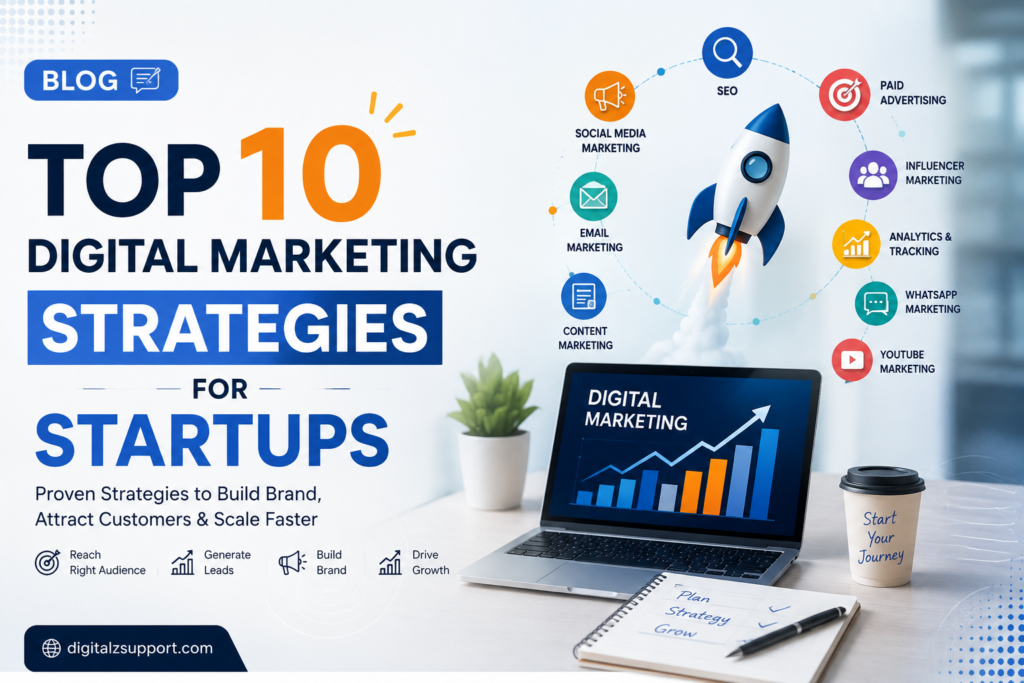
Starting a business is exciting, but getting your brand noticed in a competitive market can be challenging. For startups, digital marketing provides an affordable and measurable way to reach potential customers, build brand awareness, generate leads, and increase sales.
Unlike traditional marketing, digital marketing allows startups to target specific audiences, track campaign performance, and optimize strategies based on real-time results. However, using every marketing channel at once is not always the best approach. Startups should focus on strategies that match their goals, audience, budget, and stage of growth.
In this blog, we explore the top 10 digital marketing strategies for startups that can help new businesses establish a strong online presence and achieve sustainable growth.
What Is Digital Marketing for Startups?
Digital marketing for startups involves promoting products or services through online channels such as search engines, social media platforms, websites, email, online advertising, and content marketing.
A well-planned digital marketing strategy helps startups:
- Build brand awareness
- Reach their target audience
- Generate qualified leads
- Increase website traffic
- Improve customer engagement
- Generate online sales
- Build long-term customer relationships
- Measure marketing performance
The key is to choose the right combination of strategies instead of spending money without a clear objective.
Top 10 Digital Marketing Strategies for Startups
1. Build a Professional Website
Your website is often the first place potential customers go to learn about your startup. A professional, mobile-friendly, fast-loading website can improve credibility and make it easier for visitors to understand your products or services.
Your website should include clear information about your business, services or products, benefits, contact details, testimonials, FAQs, and strong calls to action.
For startups, website development should focus on both user experience and search engine optimization (SEO). A visually attractive website is valuable, but it should also be easy for search engines to crawl and users to navigate.
Important website elements include:
- Mobile responsiveness
- Fast loading speed
- Simple navigation
- Clear headlines
- Strong call-to-action buttons
- Contact forms
- SEO-friendly content
- Secure HTTPS connection
- High-quality images
A professional website creates a foundation for almost every other digital marketing activity.
2. Invest in Search Engine Optimization (SEO)
SEO is one of the most effective long-term digital marketing strategies for startups. It helps your website appear in organic search results when potential customers search for relevant products, services, or information.
For example, a startup providing website development services could target keywords such as “website development company,” “professional website development,” or location-based searches relevant to its market.
A strong SEO strategy includes:
- Keyword research
- On-page SEO
- Technical SEO
- Content optimization
- Internal linking
- Image optimization
- Local SEO
- Backlink building
- Regular content updates
SEO generally takes time, but it can generate consistent organic traffic without requiring you to pay for every website visit.
Startups should focus on high-intent and long-tail keywords because they can be more specific and closely aligned with what potential customers are searching for.
3. Create Valuable Content
Content marketing helps startups attract, educate, and convert potential customers. Instead of directly promoting your business in every piece of content, provide useful information that solves your audience’s problems.
You can create:
- Blog posts
- How-to guides
- Case studies
- Infographics
- Videos
- FAQs
- Industry reports
- Social media content
- Educational posts
For example, a digital marketing startup could publish articles such as “Top 10 Google Ads Mistakes Startups Should Avoid” or “How SEO Helps Small Businesses Generate Leads.”
High-quality content can support SEO, increase website traffic, establish authority, and provide material for social media and email marketing.
The goal is not simply to publish more content. The goal is to publish useful, original, relevant, and audience-focused content consistently.
4. Use Social Media Marketing
Social media marketing allows startups to build relationships with their target audience and increase brand visibility.
Depending on your audience and industry, you can use platforms such as Instagram, Facebook, LinkedIn, YouTube, and other relevant channels.
A startup can use social media to:
- Introduce its brand
- Showcase products or services
- Share educational content
- Publish customer testimonials
- Promote offers
- Answer customer questions
- Build a community
- Drive website traffic
Consistency is more important than simply posting frequently. Create a social media content strategy with different content categories such as educational, promotional, entertaining, behind-the-scenes, and customer-focused content.
Startups should also monitor engagement metrics to understand what content their audience responds to most effectively.
5. Run Meta Ads
Meta Ads can help startups reach specific audiences through platforms such as Facebook and Instagram.
Paid social advertising is particularly useful when a startup wants faster visibility, lead generation, website traffic, engagement, or conversions.
Depending on the business objective, startups can test different campaign goals and creative formats.
Effective Meta advertising usually requires:
- A clearly defined target audience
- Strong ad creatives
- Compelling copy
- A clear offer
- Appropriate campaign objectives
- Landing page optimization
- Conversion tracking
- Continuous testing
Startups should avoid spending their entire budget on one advertisement without testing. Test different headlines, images, videos, audiences, and offers to identify what produces the best results.
The objective should be to improve return on advertising spend rather than simply increase impressions or clicks.
6. Use Google Ads for High-Intent Customers
Google Ads can be highly valuable for startups because it allows businesses to reach people who are actively searching for relevant products or services.
For example, someone searching for “digital marketing agency for startups” may already have a business need. This makes search advertising useful for capturing high-intent traffic.
A Google Ads strategy can include:
- Keyword research
- Search campaigns
- Conversion tracking
- Responsive search ads
- Location targeting
- Negative keywords
- Landing page optimization
- Remarketing
Startups should carefully monitor their advertising budget and focus on keywords that are relevant to their products or services.
Combining Google Ads with SEO can provide both short-term visibility and long-term organic growth.
7. Build an Email Marketing Strategy
Email marketing remains a useful channel for nurturing prospects and maintaining customer relationships.
Startups can collect email addresses through website forms, lead magnets, newsletters, product registrations, or other permission-based methods.
Email campaigns can be used for:
- Welcome emails
- Educational newsletters
- Product announcements
- Special offers
- Follow-ups
- Customer retention
- Lead nurturing
Personalization can make emails more relevant to subscribers. Instead of sending exactly the same message to everyone, startups can segment their audience according to interests, behavior, customer stage, or previous interactions.
A successful email strategy focuses on delivering value rather than sending excessive promotional messages.
8. Focus on Local SEO
For startups serving customers in a specific city or geographical area, local SEO can be extremely important.
Local SEO helps businesses become more visible when people search for nearby products and services.
Startups should optimize their online business information and maintain consistency across relevant platforms.
Important local SEO activities include:
- Optimizing your Google Business Profile
- Using location-based keywords
- Creating location-specific website content
- Collecting genuine customer reviews
- Maintaining accurate business information
- Building relevant local citations
- Creating locally relevant content
For example, a startup serving Pune customers could target relevant searches involving “digital marketing agency in Pune” or specific service-and-location combinations.
Local SEO can help startups attract customers who are already looking for businesses in their area.
9. Use Video Marketing
Video has become an important part of modern digital marketing. Startups can use video to explain products, demonstrate services, educate customers, and communicate their brand personality.
Video content can include:
- Short-form social media videos
- Product demonstrations
- Tutorials
- Customer testimonials
- Behind-the-scenes videos
- Educational videos
- Explainer videos
- Live sessions
Video can make complex information easier to understand and provide a more engaging way to communicate with potential customers.
Startups do not always need expensive production equipment. A clear message, good lighting, understandable audio, and useful content can be more important than having a large production budget.
10. Track Analytics and Optimize Campaigns
One of the biggest advantages of digital marketing is the ability to measure results.
Startups should regularly analyze their marketing performance instead of relying only on assumptions.
Important metrics may include:
- Website traffic
- Leads
- Conversion rate
- Cost per lead
- Customer acquisition cost
- Return on ad spend
- Engagement rate
- Email open and click rates
- Organic search traffic
- Sales revenue
Analytics can help identify which campaigns are producing results and where improvements are needed.
For example, if an advertisement generates many clicks but very few leads, the problem may be the landing page, offer, targeting, or message.
Digital marketing should therefore be treated as a continuous testing and optimization process.
How Startups Can Create a Digital Marketing Plan
Having ten strategies does not mean a startup needs to implement all ten immediately. A better approach is to prioritize strategies according to business objectives.
Step 1: Define Your Target Audience
Understand who your ideal customer is, including their needs, problems, interests, location, and buying behavior.
Step 2: Set Clear Marketing Goals
Your objectives could include increasing website traffic, generating leads, building brand awareness, increasing sales, or improving customer retention.
Step 3: Choose the Right Channels
Select channels based on where your target audience spends time and where your business can achieve measurable results.
Step 4: Create a Content Strategy
Plan blog articles, social media posts, videos, emails, and other content around your audience’s questions and problems.
Step 5: Set a Realistic Budget
Divide your marketing budget between activities such as SEO, content creation, social media, paid advertising, website development, and analytics.
Step 6: Measure Results
Track important KPIs regularly and identify which activities are generating the best results.
Step 7: Test and Improve
Digital marketing is not a one-time activity. Continue testing different strategies, creatives, audiences, keywords, landing pages, and offers.
Common Digital Marketing Mistakes Startups Should Avoid
Startups often make marketing mistakes because of limited budgets or a lack of experience. Some common mistakes include:
- Trying to target everyone
- Not having a clear marketing objective
- Ignoring SEO
- Using an outdated website
- Posting inconsistently on social media
- Spending money on ads without tracking conversions
- Focusing only on likes and followers
- Ignoring customer reviews
- Not testing advertising campaigns
- Expecting immediate SEO results
Avoiding these mistakes can help startups use their marketing budget more efficiently.
Why Digital Marketing Is Important for Startup Growth
Digital marketing gives startups an opportunity to compete with larger businesses by reaching specific audiences and measuring marketing performance.
A small business can use SEO to attract organic visitors, social media to build a community, Google Ads to capture high-intent searches, Meta Ads to reach targeted audiences, content marketing to build authority, and email marketing to nurture potential customers.
The biggest advantage is that startups can analyze results and make data-driven decisions. Instead of spending blindly, businesses can identify what works and allocate resources accordingly.
Final Thoughts
Building a successful startup requires more than having a great product or service. Customers need to discover your business, understand its value, trust your brand, and have a simple way to take action.
The top 10 digital marketing strategies for startups discussed in this guide—professional website development, SEO, content marketing, social media marketing, Meta Ads, Google Ads, email marketing, local SEO, video marketing, and analytics—can provide a strong foundation for online growth.
Startups should not try to implement everything at once. Begin with the strategies that best match your target audience and business objectives. Measure the results, learn from the data, and continuously improve your marketing approach.
With the right strategy, consistent execution, and data-driven optimization, digital marketing can help startups build visibility, generate qualified leads, acquire customers, and create sustainable long-term growth.